Saturday, April 9, 2016

Shakespeare -- America's Premiere "Mad Man"

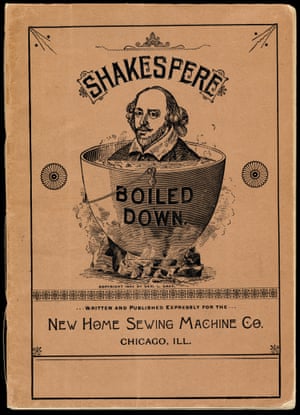
shakespeare in advertising sewing machine

He's the real thing: how Shakespeare influenced the American ad industry
From Abraham Lincoln to Coca-Cola, the Folger Shakespeare Library shows how the Bard and his plays became embedded in American history and advertising


A handsomely bound complete works of William Shakespeare stands upright beside opera glasses, a blue lace handkerchief and a single rose. On the wall is a picture of President Thomas Jefferson’s house Monticello and an article torn from a newspaper about an “All-American football team”. And also visible is a red badge that says “Coca-Cola 5c”, an open bottle of Coke and a big silhouette of a girl drinking the same. The caption says: “Thirst, too, seeks quality.”

Shakespeare meets Mad Men in this display of how the American advertising industry deployed the Bard of Avon to add a touch of class to the postwar consumer boom. The 1949 Coke ad is among an array of beguiling cultural artifacts now on show in America’s Shakespeare at the Folger Shakespeare Library in Washington DC, coinciding with the imminent 400th anniversary of the playwright’s death.

As she put the finishing touches to the exhibition on Wednesday, curator Georgianna Ziegler looked at the Coca-Cola ad and remarked: “Isn’t that interesting as a cultural moment, bringing all these things together: Coke is popular but it’s also classy; it can be enjoyed by people who go to opera and people who go to football; it’s also very American. I think that’s a fascinating piece of advertising. It says a lot about what people saw as the role of Shakespeare in American society.”

As if to prove the old adage that the chief business of the American people is business, Shakespeare has appeared as a salesman thousands of times, the exhibition notes, pushing everything from sewing machines to cigars to Levi’s, from fishing reels, beer and whiskey to cough syrup, cars and mobile phones.
Indeed, the first reproduction of Shakespeare’s image to appear in America was in an advert: an engraving based on his statue at Westminster Abbey used to promote a stationery company in Philadelphia. It ran in a 1787 volume of the Columbian Magazine that contained articles such as “A letter in praise of laughter”, “A Whimsical Solution to the Ancient Problem of Prometheus” and “Verses by a French Gentleman Addressed to his Bed”. It is also on display at the Folger.

“I speculate that Shakespeare was a sign of class and elegance – that is the raison d’ĂȘtre behind most of the adverts using him,” Ziegler said. “Shakespeare was something a lot of people knew at that time; it was part of everyday life. They weren’t studying him in school so much, but they were memorising speeches: elocution was a big thing.”

The exhibition’s touchscreens include various TV ads, most recently from Under Armour sports clothing whose commercial last year “Shakespeare Got it All Wrong”. In a rebuttal to “All the world’s a stage, and all the men and women merely players,” actor Jamie Foxx declares: “Mr Shakespeare never met Stephen Curry,” describing the basketball star as a “new creative genius” and “patron saint of the underdog”.

America’s fascination with Shakespeare is older than the republic itself. One of the prize exhibits is a new acquisition, the earliest documented ownership of a Shakespeare folio in the New World. It is listed on a blank page in a 1673 English translation of Juvenal that belonged to Major Edward Dale, a royalist who fled to America after the English civil war.

As the colonists rebelled against British rule and its punitive taxes, leading to the revolutionary war, both sides reached for Hamlet. “Be taxt, or not be taxt, that is the question,” wrote a patriot in 1770, while a loyalist Tory expressed uncertainty about whether to subscribe to a boycott of British goods in 1774: “To sign, or not to sign? That is the question.”

Likewise soldiers on both sides of the American civil war performed his plays in between battles. The exhibition includes an 1864 photo and New York playbill for Julius Caesar starring John Wilkes Booth and his two brothers to raise funds for a Shakespeare statue in Central Park. Six months later, Booth shot Abraham Lincoln at Ford’s Theatre in Washington and, the display shows, posters announced the president’s death with quotations from Macbeth.

A collectible card issued by Liebig’s Extract of Meat Company portrays a scene from Shakespeare’s play Macbeth. Photograph: Folger Shakespeare Library  It was a work that both men particularly admired. “I think none equals Macbeth,” wrote Lincoln, who often quoted the playwright, in a letter also on public view. As Booth fled into hiding, he also quoted from the Scottish play in the last words of his diary: “I must fight the course. ’Tis all that’s left in me.”
German, Irish, Italian and Russian immigrants put their own spin on the Bard, but African American actors Ira Aldridge and Paul Robeson were forced to develop their careers in Europe. Shakespeare’s plays were raw material for hundreds of silent films, with Richard III (1912) the first full-length feature; actor Frederick Warde often appeared at screenings and read extracts from the play during the changing of the reels. Then came gloriously American musical takes on the canon such as Kiss Me Kate and West Side Story.

When television arrived, the DuMont network came up with the strapline: “Verily Mr Shakespeare. All the world’s a stage … with television.” Ziegler observed: “Every time a new medium was introduced, Shakespeare was there. It made this new media OK because you can do what Shakespeare did.”

The exhibition includes cartoons, promptbooks, radio broadcasts and theatrical costumes. Perhaps the unlikeliest photo is of an American soldier in Vietnam with a copy of The Taming of the Shrew strapped to his helmet. An “Armed Services Edition” of Henry V was put out for the second world war and reprinted for troops in Iraq.

Created by oil tycoon Henry Clay Folger and his wife Emily, the library has the world’s biggest Shakespeare collection and a working theatre. Ziegler, its associate librarian and head of reference, recalled that in pre-internet days she would often get calls from the nearby Congress asking for Shakespearean quotations to leaven political speeches. “I remember Al Gore’s office called asking for a quotation from Coriolanus. I said, ‘what about?’, but they wouldn’t tell me. I don’t know if they ever used it.”

Shakespeare in America is one of the subjects considered in Andrew Dickson’s book Worlds Elsewhere: Journeys Around Shakespeare’s Globe. He said on Thursday: “One of the fascinating things about American Shakespeare, particularly during the 19th and early 20th centuries, is how the plays come to saturate culture at every level, from east coast libraries and reading societies to minstrel shows and advertising hoardings.

“For advertisers in particular it’s a way of showing off your sophistication – if you’re smart enough to have brushed up on your Shakespeare, you’re smart enough to buy our product. My own favourite is a Ford ad from 1964 called ‘Seven Characters in Search of Seven Cars’, which suggests that the perfect car for Cleopatra is a Capri. Prospero from The Tempest only gets a Cortina, which sounds a bit of a raw deal.”

Sunday, April 3, 2016

Shakespeare Plays Best Suited to "Diverse" Casting

400 years after Shakespeare's death,

 a diverse world is his stage

382 1 LINKEDIN 2 COMMENTMORE
 
Here's a dramatic irony: The playwright who gave us the most high-profile forum for diversity is a long-dead white male whose work was, in his day, performed exclusively by men who shared his skin color.

William Shakespeare shuffled off his mortal coil 400 years ago this month (April 23 is the observed date), and while his plays remain as ubiquitous as ever, their presentation has certainly evolved. As concerns about the representation of different races, genders and perspectives have embroiled Hollywood and mass media, artists have continued to look to the Bard to examine changing times and reach wider audiences.

This year has already brought one Hamlet starring a black actor — Paapa Essiedu, who plays the character as a modern graffiti artist in the Royal Shakespeare Company's current production, in the playwright's native Stratford-upon-Avon — and another, at Baltimore's Cohesion Theatre Company, depicting the prince of Denmark as a lesbian. Broadway's last Romeo and Juliet, staged in 2013, cast Orlando Bloom and African-American actress Condola Rashad as the doomed young lovers, and its most recent Julius Caesar, in 2005, starred Denzel Washington as Brutus.
"Shakespeare's writing has a malleability and an accessibility like that of no other dramatist," says British film and stage star David Oyelowo. In 2000, long before earning acclaim for his portrayal of Martin Luther King, Jr. in Selma, Oyelowo played Henry VI in the first Royal Shakespeare Company production to cast a black actor as one of the Bard's kings.

"There was a bit of noise about it at first," recalls Oyelowo, who will play Othello this fall in a New York Theatre Workshop staging, opposite Daniel Craig's Iago. "But once we began performing, the focus went back to the plays, which was wonderfully exonerating."

Diversity got an earlier boost in the USA, with the support of producers such as John Houseman — who worked with Orson Welles when the latter directed an all-black Macbeth in Harlem and on Broadway (briefly) in 1936 — and Joseph Papp, founder of the New York Shakespeare Festival, precursor to the Public Theater.
Papp championed what came to be called "non-traditional casting," a practice that gained momentum generally in theater. Through the Shakespeare Festival — which continues as the Public's Shakespeare in the Park series — he offered free performances of landmark productions such as a 1973 King Lear with James Earl Jones in the title role. The great Puerto Rican actor RaĂșl JuliĂĄ, a Shakespeare Festival stalwart, played the sinister Edmund.

For the Public's current artistic director, Oskar Eustis, the approach suits "a great writer who was writing for the most diverse audience that had gathered for secular entertainment in years." That audience included uneducated groundlings — originally, an Elizabethan term for spectators in the theater pit — along with academics, aristocrats and royalty. "Shakespeare had to appeal to all those people, and his plays still have that astonishing ability to speak to all levels of society."

That constancy is matched by an adaptability that has accommodated shifting social mores. This year's Shakespeare in the Park series launches May 24 with The Taming of the Shew, helmed by esteemed British director Phyllida Lloyd and featuring an all-female cast. Eustis had wanted to produce the comedy that gave us the wickedly dueling Katherina and Petruchio for years, but says, "A man bringing a woman to heel is not what I wanted to represent on stage ...In Shakespeare's time, it would have been performed by all men. But we're flipping that, which makes it considerably more interesting, and fun."

Women playing men in Shakespeare's plays is hardly a new phenomenon, of course. Venerated English stage and screen actress Harriet Walter, recently familiar to Americans for her stint on Downton Abbey, had "kind of given up on Shakespeare," she says, before returning to him in the roles of Brutus and Henry IV in productions by London's Donmar Warehouse. "That ability to make that language come alive dramatically is common to men and women, like playing Beethoven," Walter says.

British-born Zainab Jah, currently acting alongside Lupita Nyong'o in Broadway's acclaimed Eclipsed, joined a list of notable female Hamlets stretching back to Sarah Bernhardt when she played the part last year at Philadelphia's Wilma Theater. Neither Jah's gender nor her race — she is black — fazed young audience members who attended talk-backs after student matinees. "Their teachers had questions," Jah remembers, "but it didn't matter to the students."


Cohesion Theatre artistic producer Alice Stanley, who directed the recent Hamlet with a lesbian protagonist, is in her 20s, and has re-interpreted other Shakespeare plays to incorporate transgender characters. "People use Shakespeare's work to touch on political issues all the time," Stanley says. "Gender diversity is at the forefront right now, and there's a lot that can be played with and reimagined."

Walter points out that "Shakespeare's theater was not naturalistic," a factor that has fueled the imaginations of his interpreters. Brandi Wilkins Catanese, associate professor of performance studies and African-American studies at the University of California at Berkeley, notes that "for a contemporary audience, Shakespeare's plays don't exist through a realistic framework. They're already going outside their frames of reference in terms of plausibility and language...That can put your mind in a more expansive way of thinking about how to materialize the text."

Shakespeare himself "played with layers of gender and identity," notes Christopher Liam Moore, who is directing one showcase, Twelfth Night, for the Oregon Shakespeare Festival. OSF is staging five works in repertory to commemorate the anniversary of the playwright's death; others include The Winter's Tale, in a production (starting June 9) set in dynastic China and the American West and directed by a Chinese-American woman, Desdemona Chiang. Korean-American actress Amy Kim Waschke is cast as the queen Hermione, while Twelfth Night's Olivia — in Moore's reading, a black starlet in 1930s Hollywood — is played by an African-American, Gina Daniels.

Oregon Shakespeare Festival artistic director Bill Rauch notes that in its 2011 staging of Julius Caesar, the title character was played by a Latina, Vilma Silva. "As you approached the theater, we had a series of banners of world leaders who had been revered and then assassinated," Rauch says. "And they were men and women, black and white and Asian and Latino. Then you watched the play and got Shakespeare's larger truth about the human impulse."

In preparing to play Othello, Oyelowo has been exploring parallels between Shakespeare's Moor and our current president. "Othello, not unlike Obama, is powerful; and because of the color of his skin, he is symbolic in ways that empower some people and threaten others. We're seeing something like that clearly played out in America today."

No doubt Shakespeare's works are inspiring other comparisons right now, and more reflection on the circumstances that unite and divide us. "That's why he is the first name we think of when we think of theater," says Walter. "Because all of us want to express ourselves through his words, no matter where we come from or what color or shape or size we are. Shakespeare still speaks for the whole of humanity."

Wednesday, March 30, 2016

Ruth Bader Ginsburg will make a cameo in a production of Shakespeare's The Merchant of Venice

US Supreme Court Justice Ruth Bader Ginsburg speaks at an annual Women's History Month reception hosted by Nancy Pelosi in the US Capitol building on Capitol Hill in Washington, DC. Allison Shelley/Getty Images
"I am not bound to please thee with my answers," says the judge in the famous courtroom scene in The Merchant of Venice, William Shakespeare’s play about a Venetian Jewish moneylender.

They also sound like words that Supreme Court Justice Ruth Bader Ginsburg would love to utter. She will be playing the role of the judge this summer in a production of The Merchant of Venice, marking the 500th anniversary of the Jewish ghetto in Venice.

The Merchant of Venice chronicles the persecution of a Jewish moneylender who demands payment on a defaulted loan from his Christian patron. Shylock is taken to trial, and the play concludes with him converting to Christianity. It’s a fitting story for the celebration of the Jewish ghetto, and for Ginsburg, whose Jewish identity plays a prominent role in her life outside the court.

But Ginsburg is no Shakespeare novice. She recently told Politico of her many onstage appearances in Shakespeare plays, most prominently as Dick the Butcher in Henry VI.
"I had Dick the butcher’s part, with the famous line, ‘First thing we do, let’s kill all the lawyers.’ And then I asked if I could ad-lib an addition, I checked this out in advance, and the addition was, ‘and next the reporters,’" she said, chuckling.
Her love for opera recently gained attention after the death of her close friend, Justice Antonin Scalia, with whom she frequented opera performances. Last summer, a cast even performed a one-act opera about the two justices, Scalia/Ginsburg, at a festival in Virginia.

Sunday, March 27, 2016

Scene by Scene Summary of Much Ado About Nothing

As the title of this play suggests, there’s a lot of fuss over nothing! Claudio and Hero fall in love and plan to get married, but the villainous Don John slanders Hero with false evidence. The wedding is ruined and Hero faints. Her family soon suspect slander and decide to pretend that Hero died from shock. Don John’s evil plan is soon revealed and Claudio mourns Hero’s death. Eventually, Hero is revealed to be alive and the marriage goes ahead as planned. In the play’s closing moments, it is reported that Don John has been captured for his crime.

Scene by Scene Breakdown:

Act 1

Scene 1: Don Pedro, the Prince of Aragon, returns triumphant from battle and seeks refuge in Messina. Leonato, the Governor of Messina, welcomes Pedro and his soldiers with open arms, and the sudden influx of men into the town soon stirs up some romance. Claudio instantly falls in love with Hero, and Beatrice is reunited with her old flame, Benedick – the man she loves to hate.

Scene 2: Leonato is busily preparing a great supper to welcome the war heroes to Messina when his brother brings him news: Antonio explains that he overheard Claudio confessing his love for Hero.

Scene 3: The villainous Don John has also learned of Claudio’s love for Hero and vows to thwart their happiness. Don John is the “bastard” brother of Don Pedro – and he wants revenge for being defeated in battle.

Act 2

Scene 1: After supper, Leonato invites his guests to a great masked ball where Beatrice and Benedick continue to provide some light comedy – although they love each other, they can’t stop mocking each other long enough to admit it. Leonato gives permission for his daughter to marry Claudio in seven days time. Don Pedro and Hero decide to play cupid and plan to finally get Beatrice and Benedick to declare their love for each other.

Scene 2: Hearing that they only have one week to ruin the wedding, Don John and his henchmen soon devise a plan – they intend to trick Claudio with false evidence into thinking that Hero has been unfaithful to him the night before their wedding.

Scene 3: Meanwhile, Don Pedro tricks Benedick into thinking that Beatrice is head-over-heals in love with him, but dare not admit it in case Benedick mocks her. Benedick, who overhears this staged conversation, is completely fooled and starts musing on his love for Beatrice.

Act 3

Scene 1: Hero keeps her end of the bargain and manages to fool Beatrice into thinking that Benedick loves her, but dare not admit it to her. She, too, overhears Hero’s staged conversation and starts musing on her love for Benedick.

Scene 2: It is the night before the wedding and Don John prepares to execute his plan. He finds Claudio and tells him of Hero’s impurity. At first disbelieving, Claudio eventually agrees to go with Don John and see for himself.

Scene 3: Dogberry, a bumbling constable, instructs his watchmen to be extra vigilant because of the important wedding in the morning. The watchmen later overhear Don John’s henchmen drunkenly bragging about how they successfully tricked Claudio – they are promptly arrested.

Scene 4: It is the morning of the wedding and Hero is nervously preparing before the wedding party arrive and take her to church.

Scene 5: Leonato is hastily making his way to the wedding, when he is stopped by Dogberry. Dogberry is a bumbling idiot and fails to communicate what his watch have discovered. Frustrated, Leonato tells him to interview the suspects and speak to him after the wedding ceremony.

Act 4

Scene 1: Claudio publicly reveals Hero’s infidelity halfway through the marriage ceremony. Hero is stunned by the accusation and soon faints in the chaos that follows. Once the wedding party disbands, the Friar becomes suspicious and convinces Leonato, Beatrice and Benedick to pretend that Hero died from shock until they discover who has slandered her – Benedick immediately suspects Don John. Left alone, Beatrice and Benedick finally declare their love for each other. Beatrice asks Benedick to kill Claudio to avenge the shame he has brought on her family.

Scene 2: The trail of Don John’s henchmen happens after the wedding – too late to save the day. By now, the whole town thinks that Hero has died and they go to inform Leonato that his daughter died in vain.

Act 5

Scene 1: People are beginning to turn against Claudio; both Leonato and Benedick accuse him of wronging Hero, and then Dogberry reveals Don John’s henchmen. Claudio realizes that he was tricked by Don John and tries to apologize to Leonato. Leonato is surprisingly forgiving (because he knows that his daughter didn’t actually die). He says that he will forgive Claudio if he marries his cousin the following day
.
Scene 2: Beatrice and Benedick still can’t stop insulting each other. They soon talk themselves out of having ever admitted love for one another at all

Scene 3: By night, Claudio visits Hero’s tomb to mourn and hangs an epitaph – as Leonato requested.
Scene 4: At the wedding, Claudio is amazed when Hero is revealed to be alive and as virtuous as ever. Benedick and Beatrice finally admit their love for each other in public. Moments before the celebrations begins, a messenger arrives and reports that Don John has been captured.

Shakespeare's skull probably stolen by grave robbers, study finds

Radar scan of Bard’s grave for Channel 4 documentary shows his head appears to be missing – but it puts other myths to bed

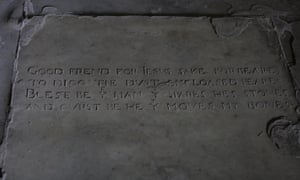
Inscription on Shakespeare’s grave at Holy Trinity church in Stratford-on-Avon
 
Inscription on Shakespeare’s grave at Holy Trinity church in Stratford-on-Avon. Photograph: Production Company/Channel 4

A story often dismissed as wild fiction, that 18th-century grave robbers stole Shakespeare’s skull, appears to be true, archaeologists have said.
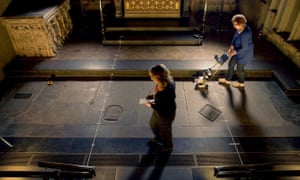
The first archaeological investigation of Shakespeare’s grave at Holy Trinity church in Stratford-on-Avon has been carried out for a documentary to be broadcast by Channel 4 on Saturday.
The most striking conclusion is that Shakespeare’s head appears to be missing and that the skull was probably stolen from what is a shallow grave by trophy hunters.
Kevin Colls, the archaeologist who led the team, said the grave was not as they had expected. “We came across this very odd, strange thing at the head end. It was very obvious, within all the data we were getting, that there was something different going on at that particular spot. We have concluded it is signs of disturbance, of material being dug out and put back again.”

Archaeologists conducting the survey of William Shakespeare’s grave at Holy Trinity church
 
Archaeologists conducting the survey of William Shakespeare’s grave at Holy Trinity church. Photograph: Production Company/Arrow Media/Channel 4
There is also “a very strange brick structure” that cuts across the head end of the grave, he said.
All of that gives credence, Colls said, to a story published in the Argosy magazine in 1879 that Shakespeare’s skull was stolen from Holy Trinity in 1794.
“Grave-robbing was a big thing in the 17th and 18th century,” said Colls. “People wanted the skull of famous people so they could potentially analyse it and see what made them a genius. It is no surprise to me that Shakespeare’s remains were a target.”
Shakespeare’s grave is visited by hundreds of visitors each year, a number that may increase in 2016 – the 400th anniversary of his death.
It carries no name, only a slightly disturbing warning: Good friend, for Jesus’ sake forbear, / To dig the dust enclosed here. / Blessed be the man that spares these stones, / And cursed be he that moves my bones.”
The archaeological team used non-invasive ground-penetrating radar (GPR) to examine the grave and were able to put to bed a few myths about Shakespeare’s burial.

GPR image of Shakespeare's grave
Pinterest
GPR image showing rectangular feature at the head end of the grave, with apparent brick repair outlined in red. Photograph: Production Company/Arrow Media/Channel 4
For example, one story suggests he was buried standing up, as his friend and fellow writer Ben Jonson is in Westminster Abbey. Another claims that he was buried 17ft deep to avoid being disturbed, while one says he was buried in a family tomb.
None of those stories are true, the team has concluded. Instead he is buried about 3ft deep and had been wrapped simply in a shroud rather than placed in a coffin.
Their conviction that Shakespeare’s skull was stolen led the team to investigate another story – that the real skull is in fact 15 miles away in the crypt of St Leonard’s church in the village of Beoley, Worcestershire.

The team scanned the skull and carried out a forensic anthropological analysis and the results revealed it could not be Shakespeare. “It was an unknown woman in her 70s,” said Colls, whose team even did a facial reconstruction to hammer the point home.
Colls said he is convinced Shakespeare’s skull was removed from his grave but accepts the evidence is not conclusive. However, the vicar of Holy Trinity, the Rev Patrick Taylor, is not so certain.
“We now know much more about how Shakespeare was buried and the structure that lies underneath his ledger stone,” he said. “We are not convinced, however, that there is sufficient evidence to conclude that his skull has been taken.
“We intend to continue to respect the sanctity of his grave, in accordance with Shakespeare’s wishes, and not allow it to be disturbed. We shall have to live with the mystery of not knowing fully what lies beneath the stone.”
Secret History: Shakespeare’s Tomb is on 26 March 8pm on Chan

Shakespeare's skull: New chapter in hunt for missing head

  • 27 March 2016


It's a mystery that has gripped historians and Shakespeare experts for generations - and one archaeologists believe they could have finally found an answer to. 

After a hi-tech investigation concluded the legendary playwright's skull was probably taken by trophy hunters more than 200 years ago, which direction should the search for his missing bones now take?
As a Channel 4 documentary reveals his Stratford resting place has been disturbed at the head end, and proves a mystery skull thought to be his is actually that of a woman, new theories about what happened to Shakespeare's head are beginning to emerge.

Here, experts and enthusiasts give their opinions on where the hunt for the elusive part of his skeleton should go - or, as we approach the 400th anniversary of his death, whether it is finally time to let him rest in peace.
y

'It's not quite back to square one - but we need to look at the legends of other churches to see if they hold the key'

Kevin Colls is the Staffordshire University archaeologist who led the investigation into Shakespeare's grave at Holy Trinity Church, Stratford.

He firmly believes the findings of a disturbance of, and repair to, the tomb are too similar to the trophy-hunting allegations printed in 1879 to dismiss them - and plans to keep looking for the skull.
"Our research will continue - we're going to try and do as much as we can to locate it," he said. "Because we had two possible locations - Holy Trinity and St Leonard's in Beoley - and we've ruled out those, we now need to look through documents again to help us find where it could be.
"It's not quite back to square one. We need to look at the myths and legends surrounding other churches in Stratford and the West Midlands to see if any of those could hold the key.
"It is of course possible that the skull was removed before the burial, and what our research has done is open a whole can of worms.

"But the fact is that our findings correlate so well with the documented theft in 1879 - particularly the reference to the grave being shallow. If it was going to be made up, the story would be entirely different.

"The evidence of disturbance to the grave and repair to the chancel floor leads us to this conclusion."

'It's possible the skull was removed by a relative and reburied'

Chris Laoutaris, of the University of Birmingham's Shakespeare Institute, is a Renaissance burial customs expert - and wonders whether a loved one is responsible for the disappearance of the playwright's skull, which he thinks could lie in a relative's tomb.

"Of course, it's possible that his head was looted in 1794, as the Argosy Magazine had claimed somewhat controversially in 1879," he said.

"But then another question occurred to me: what if Shakespeare's skull was disinterred not long after his burial and reburied with another family member or loved one?

"In an age in which high mortality rates meant that death was a far more vivid and ever-present reality than today, reacquainting oneself with the relics of the dearly departed in this manner may have seemed less strange, and was not in fact unheard of.

"The most well known example is that of Sir Thomas More, Lord Chancellor under Henry VIII and England's greatest humanist scholar, whose head was believed to have been lovingly preserved after his execution in 1534 by his devoted daughter Margaret More Roper.

"In 1978 archaeologists opened the Roper family burial vault in the Church of St Dunstan in Canterbury and discovered a mysterious niche behind which were remnants of a skull, almost certainly belonging to More.

"Could the mystery of Shakespeare's own skull, if indeed it is missing from his grave, owe something to a loved one's desire to be reunited with him in death? Perhaps we will never know.

"The other significant area that the archaeological investigations may shed some light on is the religious underpinnings of Shakespeare's burial. There is much controversy surrounding the possibility that Shakespeare may have been a crypto-Catholic.

"The recent archaeological investigation indicates that he was not buried in a coffin but was instead wrapped in a simple burial shroud. The plainness of the interment, without elaborate ritual trappings, suggests that this was a burial in keeping with Protestant custom.

"There is something touching about the simplicity of his burial which still speaks to us across the centuries, reminding us of the humanity of the man behind the legend."

'All we want to know is - who does our mystery skull belong to?'


re. 
 
Detailed archaeological investigations have now disproved that theory, finally determining the skull belongs to a unknown woman in her 70s.

Clergymen had previously applied to the Consistory Court to use DNA testing to discover the identity of the skull - but had the application thrown out, the Daily Telegraph reported in November 2015.

"It would have been really, really nice, to have a link with Shakespeare and it is unfortunate that we don't - but we still have an intriguing mystery about who the Beoley skull belongs to," said Mr Clark.
"The bone sits alone in a room inside the vault and will remain there until somebody wants to try and obtain permission for further testing to determine who it belongs to.

"We've discovered that the story of the removal of his skull and reburial at St Leonard's is rubbish - so what I'm interested in now is who does our skull belong to?

"We'd love to find out, but we haven't got the money.
"I'm a Shakespeare enthusiast myself, and obviously there's always going to interest in historic mysteries and getting to the truth.
"But I wouldn't want to violate his wishes."

'It's time to let Shakespeare rest in peace'

I
 
John Hogg, who has run Stratford Town Walk with his wife Helen since 2002, said the discovery was "fascinating" for them both and for the 15 guides with whom they work.
But while he's delighted the archaeological probe has put the global spotlight on to Stratford, he believes the search for the truth should end here.

"We don't know for certain that the skull is missing - it's important to remember that," said 71-year-old Mr Hogg.

"It is my personal feeling that he should be left alone now.
"He's laid there for 400 years. It's time to allow the mystery to remain just that."

Saturday, March 26, 2016

Scholars on Meaning of "Lead Apes in Hell"


a
Scholars can’t agree about what exactly is meant by  the proverb “old maids leading apes in hell.” Some say it gained popularity as a Protestant attack on the Catholic Church insistence that the unmarried refrain for sexual activity.

The following scholarly comments ( which often blatantly contradict one another) gives us a glimpse of what Shakespearean nitpicking is like.
Said to be the fate of women who die old maids, an afterlife punishment for their failure to go forth and multiply. As far as I can tell, the exact origins of the saying are unknown, though the first usage listed by the OED dates to the 16th century. Readers may have encountered the phrase before in the works of William Shakespeare. Both The Taming of the Shrew and Much Ado About Nothing make reference to leading apes into hell (not surprising given the subject matter of those plays).

H.W. Jansen suggests a somewhat different meaning for the phrase in his Apes and Ape Lore in the Middle Ages and the Renaissance. According to Jansen, leading apes into hell is not a punishment for old maids; it is a description of the dire consequences of female celibacy. By the time of the Renaissance, the ape was already well-established as a symbol for fornication. Women, by refusing to marry, forced men to seek sex outside of the marriage union, thus making them fornicators or apes. What the saying suggests is that old maids lead otherwise good men to sin, placing their immortal souls in jeopardy. Thus, a woman who does not marry leads apes into hell.
___________________________
Q What are we meant to understand by the phrase

“Leading apes in hell” ?

MW

A Very few people seem to know that “lead” in Tudor English means to have sexual intercourse. The proverb means that women who take no part in the sexual activity of society for whatever reason will be punished by being served by apes in hell. This is not a punishment for chastity (a faithful spouse is chaste) but for failing to spread joy in the world by healthy activity.

When Shakespeare mentions “leading apes into hell”, he is being allusive, as he so often is when the real matter is coarse. His audience would have recognised the allusion immediately. There is also a madrigal verse about Messalina, going up and down the house very upset because her monkey lies a-dying. “O Death thou art too cruel to take her only jewel”, and “If her monkey die, she shall sit and cry“ Fie, fie, fie fie!”.

The Elizabethan audience would immediately have understood going “up and down”, the loss of her only jewel, and the orgasmic cries of “fie” as being a classic tudor dirty joke. Her pet ape is dying because she has deprived him of the opportunity of serving her in hell by the time-honoured method.
Benjamin Britten failed to realise this when he set this verse very piously in Our Hunting Fathers. The words for this cycle were chosen by WH Auden, who could certainly recognise a sexual allusion when he saw it. James Bowman tells me that he thinks that Auden did tell Britten, but that Britten simply thought he was being disgusting and ignored the advice.

Not the first time that a dirty joke has got past in a more innocent age
.

 Among other wedding customs alluded to by Shakespeare we may mention one referred to in "Taming of the Shrew" (ii. 1), where Katharine, speaking of Bianca, says to her father—

"She is your treasure, she must have a husband:
 I must dance bare-foot on the wedding-day,
 And, for your love to her, lead apes in hell,"

it being a popular notion that unless the elder sisters danced barefoot at the marriage of a younger one, they would inevitably become old maids, and be condemned "to lead apes in hell."

 The expression "to lead apes in hell," applied above to old maids, has given rise to much discussion, and the phrase has not yet been satisfactorily explained. Steevens suggests that it might be considered an act of posthumous retribution for women who refused to bear children, to be condemned to the care of apes in leading strings after death. 

Malone says that "to lead apes" was in Shakespeare's time one of the employments of a bear-ward, who often carried about one of these animals with his bear." Nares explains the expression by reference to the word ape as denoting a fool, it probably meaning that those coquettes who made fools of men, and led them about without real intention of marriage, would have them still to lead against their will hereafter.

In "Much Ado about Nothing" (ii. 1), Beatrice says, "Therefore I will even take sixpence in earnest of the bear-ward, and lead his apes into hell." Douce 1 tells us that homicides and adulterers were in ancient times compelled, by way of punishment, to lead an ape by the neck, with their mouths affixed in a very unseemly manner to the animal's tail.
________________________________________________________________________