
by Ed Friedlander M.D.
Speak what we feel, not what we ought to say. -- Edgar If you are a student assigned to read or see King Lear, or an adult approaching it for the first time, your experience will be special. These notes will help you get started. | 
|
Geoffrey of Monmouth ("History of the English Kings", around 1140), who provides our oldest written reference to King Lear (spelled "Leir"), describes him as a pre-Christian warrior king in what is now southwest England. (Click here to read it yourself.) This area now includes Cornwall (origin of cornish game hens.) Saint Albans ("Albany", for which the capital of New York State is named, is farther away. In the old story remembered by Geoffrey, Lear asked his three daughters whether they loved him. Two claimed to do so extravagantly, while the third said she loved him only as a daughter should. Lear disinherited the honest daughter. The story appears elsewhere in world folklore; there is an Eastern European version in which the honest daughter says she loves her father as much as she loves salt. Lear went to live with his first daughter, bringing a hundred followers. She demanded that he reduce his followers to fifty. Lear then went to live with the other daughter, who reduced the number to twenty-five. Lear went back and forth between the daughters until he was alone. Then the third daughter raised an army, defeated the other two, and restored him to his kingdom. (The story appears in Holinshed, who adds that Cordelia succeeded her father as monarch and was deposed by the sons of her sisters.) This tale about how actions speak louder than words had recently been played on the London stage in "The True Chronicle of King Leir." We have seen the essential story once again in the Japanese Ran, and more recently in A Thousand Acres, an intelligent feminist tale, with the two older daughters as incest survivors who have spent their lives cajoling a crazy, abusive father and protecting their youngest sister. A different family problem from the Lear's -- the Fool says the king made his daughters his mothers (disciplinarians) rather than his wives, the rod refers to a stick for spanking ("spare the rod and spoil the child"), and in III ii, King Lear calls on the storm to punish the crimes of others that usually go unpunished -- close pent-up guilts -- including incest and perjury but also planning murders and performing elder abuse.) Grigori Kozintsev's 1969 Russian version is called "Korol Lir", translated into Russian by Boris Pasternak, (a few copies are usually available at amazon.com, and it is now re-released by the BBC). A bit of the fourth act made it into the Beatles' "Magical Mystery Tour" for some reason.
Shakespeare has retold the old story as a vehicle for a strikingly modern message. Many people consider King Lear to be his finest work. Whether or not you agree with his vision of a godless universe in which our only hope is to be kind to one another, you will recognize the real beliefs of many (if not most) of your neighbors.

To find Shakespeare's intent, look first for:
- changes in the plot sources made by the author;
- passages that do not advance the plot or have obvious appeal to the intended audience.
The main plot

Lear is king of Britain. He is an old, highly successful warrior king. (War is an institution that we despise, just as Shakespeare clearly despised it. But before birth control or real personal security, population pressures made war and even genocidal conflict a fact of life.) Like Hamlet and Othello, we are impressed with him because of what others say about his background. (You can find examples. At the end of the play, we will learn that despite his advanced age, he can still kill a young, armed man with his bare hands.) King Lear has decided to retire and to divide his kingdom among his three daughters and their husbands. His stated intention is to prevent future conflict. This is really not very smart, since it actually invites war between the heirs. Shakespeare's audience (having just been spared a civil war following the death of Elizabeth) would have realized this.
King Lear has staged a ceremony in which each daughter will affirm her love for him. Whether this has been rehearsed, or the daughters forewarned, we can only guess. Goneril and Regan may have been embarrassed. Goneril says she loves her father more than she can say. King Lear thanks her and gives her Third Prize. Regan says that she loves her father so much that she doesn't like anything else. King Lear thanks her and gives her Second Prize. Cordelia says that she loves her father exactly as a daughter should. King Lear goes ballistic and disinherits her, and banishes the Earl of Kent for speaking in her defense. First Prize is divided between the other two daughters.
 You can decide whether King Lear is showing
early signs of mental illness (as his other daughters
think), or whether he just wanted an excuse to give Cordelia the best share
of the kingdom and she just spoiled it.
Cordelia has been courted by the Duke of Burgundy and the King of
France. Burgundy says he will not marry a woman with no property.
France is more clever. He swears that he loves Cordelia, and
marries her. This is an obvious plan to make a claim on the British throne, and
Shakespeare's audience would have realized this. We'll see
the proof later. France may or
may not be sincere in loving Cordelia. We won't know.
You can decide whether King Lear is showing
early signs of mental illness (as his other daughters
think), or whether he just wanted an excuse to give Cordelia the best share
of the kingdom and she just spoiled it.
Cordelia has been courted by the Duke of Burgundy and the King of
France. Burgundy says he will not marry a woman with no property.
France is more clever. He swears that he loves Cordelia, and
marries her. This is an obvious plan to make a claim on the British throne, and
Shakespeare's audience would have realized this. We'll see
the proof later. France may or
may not be sincere in loving Cordelia. We won't know.As the basis of his retirement agreement, King Lear has stipulated that he will live alternately with his daughters, who will support him and 100 followers. When he leaves, Goneril and Regan express their understandable concern about hosting a mentally-imbalanced father and his personal army.
King Lear goes to live with Goneril. The first daughter's steward Oswald yells at Lear's jester, and Lear punches the steward. Goneril decides to assert control. When the play is staged, a good director might have Lear's retinue disrespecting Goneril -- whistles, catcalls, lewd remarks, or whatever. Kent returns in disguise to serve Lear, and we meet the jester ("Fool"). For some reason, just like Kent, the jester is loyal to the king. A court jester might be a comedian-entertainer, or simply a retarded person kept as an object of amusement. Lear's jester is specially privileged to speak the truth, which he does ironically. Both the king and the jester make reference to the jester being whipped at times -- Ian McKellen makes it clear that this is a joke, with the king tapping the face on the jester's mock scepter (bauble / marotte). You'll need to decide whether the king has always been kind to the jester, or whether the jester (like Kent) for some reason remains loyal despite past mistreatment.
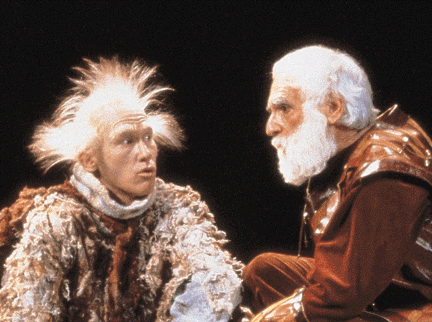
Oswald is rude to Lear, and one of Lear's knights makes an indignant speech about the king not being cared for properly. (This knight, and all the others, will soon abandon their king.) Lear yells at Oswald, Kent trips Oswald, and a scene ensues in which Goneril demands that Lear reduce the number of his followers -- evidently to 50. Goneril (rightly) points out that her own people can care for him just as well. (There's a subtlety here. In the original story, the daughters send the knights away, i.e., refuse to pay to support them. However, if you read closely, the knights are already leaving King Lear, because they can tell what is going to happen. The king is showing lapses in judgement, and has no way of forcing his daughters to honor their promise to support him. In a time of warlords, soldiers will desert when the leader shows signs of being unable to lead and/or guarantee their salaries.) Lear curses Goneril and departs for Regan's. He sends Kent before him, and Goneril sends Oswald.
Regan and her husband have gone to visit the Earl of Gloucester, and when Kent and Oswald meet at the Earl's castle, Kent picks a fight and Regan's husband puts him in the stocks. This is a serious breach of protocol, and when Lear arrives, he is furious. (Kent's difficult phrase "Nothing almost sees miracles but misery", by its context, seems to mean that when things seem to be going really badly, it's common to receive unexpected, seemingly-miraculous help.) Goneril arrives and Lear curses her again. Regan says she will allow him only 25 followers. Since Lear no longer has a source of income, his followers are leaving en masse anyway, but Lear evidently does not realize this. Lear says he will return to Goneril, but now she will not even allow 25, and the daughters re-enact the fairy-tale plot by alternately reducing the numbers, and asking "Why do you need even one follower, when we can care for you ourselves?" Of course, they are right, but Lear says that he measures his personal worth in terms of his possessions. "Reason not the need! Our basest beggars are in the poorest things superfluous. Allow not nature more than nature needs, Man's life is cheap as beast's." Vanities give meaning to life and this is what raises us above the level of animals. King Lear, now alone except for Kent and the jester, starts to cry and runs off as a storm brews. The daughters lock him out of the castle to teach him a lesson.

Lecturers who enjoy talking about "The Elizabethan World Picture", in which orders of nature reflect human law and its breakdown, will tell you that the ensuing storm mirrors the chaos in Britain. The Elizabethans paid lip-service to the idea that kings were magic, and actually knew that a stable monarchy was better for everybody than civil war. (Lawful democracy would be devised later.) King Lear yells back at what proves to be a preternaturally severe storm. His whole retinue have abandoned him except the jester, who begs Lear to go apologize to his daughters and seek shelter, and Kent, who sends to Dover, where the French army has landed in expectation of a British civil war. Even though the jester pretends to be foolish, he always knows exactly what is going on, and what's more, he is loyal to the old king. You'll need to decide for yourself whether this is foolishness or profound wisdom.
In the first storm scene, which is difficult, Lear is going crazy. He:
- first calls on the power of the storm to sterilize the human race;
- then accuses the storm of taking sides with his daughters against his dignity and being their degraded slave;
- then, realizing that people have deceived him, says the storm must be "the gods"'s way of finding and punishing secret evildoers, and that he is "a man more sinned against than sinning";
- then comments, "my wit begins to turn", i.e., he realizes he is going crazy -- in literature, becoming insane is often a metaphor for changing the way you look at yourself and the world;
- notices the jester is cold, and comments that he is also cold; this is the first time Lear has been responsive to the needs and concerns of someone else;
- accepts Kent's suggestion to take shelter in a hut.

Already inside the hut is "one of the homeless mentally-ill." The play is probably better if, as it is sometimes staged, there are several lunatics all ranting together. (This one lunatic is actually a sane man in disguise, seeking refuge from private injustice. The "extras" who served as knights in the first and second act and who will be in the battle scenes at the end can be the extra lunatics.) When he sees the hut, and before seeing the lunatic(s), King Lear realizes that what is happening to him now is what he has allowed to happen to the poor throughout his reign. "Oh, I have taken too little care of this." He suddenly realizes that his luxuries have been maintained at the expense of his poorest subjects, and that justice is only now being served on him.
When he sees the lunatic(s), Lear cracks, and says he/they must have given everything to their daughters and been turned out also. But the onset of madness confers a deeper insight. Lear sees in the naked lunatic someone who has taken nothing wrongfully from anyone, and is the essential human being. Saying that "unaccommodated man is no more but such a poor, bare, forked animal as thou art," the king rips off his clothes.
In the third storm scene, King Lear holds a trial of his two daughters, evidently mistaking a stool for Goneril, something else (I've seen a chicken used) for Regan, and so forth. In one Royal Shakespeare Company production, the king mistook a pillow that the jester was holding for Regan, and stabbed the jester to death through the pillow. The good Earl of Gloucester comes and urges Kent to take the king (who has passed out) to Dover, since his daughters' people are planning to kill him. At the end, Kent tells the jester to follow Lear. As often played, Kent discovers the jester to be dead. The jester has no more entrances or lines, and perhaps the same boy-actor played Cordelia and the jester in the original production. You can read more about Robert Armin, the beloved comedian who played Shakespeare's jesters at the time, elsewhere online.
 Kent and Lear reach Dover and Cordelia, who loves him.
Cordelia accompanies an invading French army.
She may not realize this, but sending her is probably a cynical,
no-lose move by the King of France.
If his forces win and kill the other heirs, he is now
also King of Britain. If his forces lose, the heirs will
kill Cordelia and he will be rid of a wife who is no longer
of any political value. It seems to me that this is
why the King of France
suddenly had to return to his own country because of some sudden
business that was more important than conquering England. Uh huh.
He has left his wife either to do it for him, or be killed. (Shakespeare's
English audience mostly did not like the French. Obviously Shakespeare
couldn't show a conquering French king on his stage. But having the king land and
then leave
"suddenly" lets Shakespeare make the foreign king look machiavellian. You'll
have to decide about this for yourself.)
Kent and Lear reach Dover and Cordelia, who loves him.
Cordelia accompanies an invading French army.
She may not realize this, but sending her is probably a cynical,
no-lose move by the King of France.
If his forces win and kill the other heirs, he is now
also King of Britain. If his forces lose, the heirs will
kill Cordelia and he will be rid of a wife who is no longer
of any political value. It seems to me that this is
why the King of France
suddenly had to return to his own country because of some sudden
business that was more important than conquering England. Uh huh.
He has left his wife either to do it for him, or be killed. (Shakespeare's
English audience mostly did not like the French. Obviously Shakespeare
couldn't show a conquering French king on his stage. But having the king land and
then leave
"suddenly" lets Shakespeare make the foreign king look machiavellian. You'll
have to decide about this for yourself.)
Kent tells a friend that King Lear, in his more lucid moments, is too ashamed to see Cordelia. The king reappears in a field where the Earl of Gloucester lies, his eyes having been gouged out by Regan and her husband. King Lear is now crowned and decorated with weeds and wild flowers. He wavers between hallucinations and accurate perception. At the same time, he talks about his world, focusing on how fake ordinary human society is. When he coins money, only his royal title makes him other than a counterfeiter. People pretend to be modest and virtuous, but in private are as amoral and dirty-living as animals. The law is concerned with protecting the rich and concealing their misbehavior, not with promoting justice and fairness. Regan and Goneril have played and humored him. He learned the truth only in the storm. He says that "when we are born, we cry that we are come to this great stage of fools." Cordelia's people come to bring him back to their camp, and they chase him down.
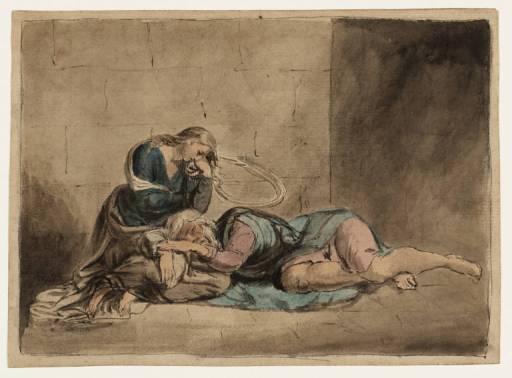
We next see King Lear asleep under the care of Cordelia. He awakes, and thinks -- correctly -- that he recognizes her. But he thinks that they are both dead. "Thou art a soul in bliss, but I am bound upon the wheel of fire, that mine own tears do scald like molten lead." Cordelia kneels, Lear tries to do the same (as in the older play), but Cordelia prevents him. Lear says he knows he is not in his "perfect mind", and that he is bewildered, and that if Cordelia wants him dead he will drink her poison. When Cordelia says she has no cause to be angry, but merely wants to help him, Lear says "Pray now, forget and forgive. I am old and foolish."
 King Lear is not about wrongs being righted.
If Shakespeare were a Hollywood writer, his king might
have returned to rulership and ("having learned to be
sensitive, and that it is all right to cry") become a champion for the
poor in his own country and set up a social agency to deal effectively with
other dysfunctional families.
King Lear is not about wrongs being righted.
If Shakespeare were a Hollywood writer, his king might
have returned to rulership and ("having learned to be
sensitive, and that it is all right to cry") become a champion for the
poor in his own country and set up a social agency to deal effectively with
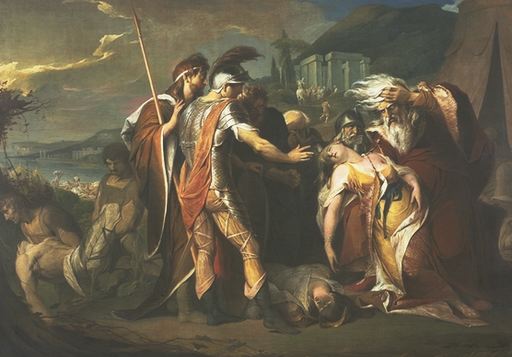
other dysfunctional families.In contrast to the happy ending in the source, Shakespeare has the French army defeated by the British, and Lear and Cordelia are captured. King Lear looks forward to happy time with his daughter in prison, merely laughing at the rest of the world. As the subplot concludes, all the villains are dead, but Cordelia has been hanged in prison. King Lear kills the hangman with his bare hands. He comes onstage, carrying Cordelia's body and howling. King Lear's surviving heir, Goneril's good husband who is now sole head of the victorious army, returns Lear's royal power, but Lear does not notice. Suddenly uncertain whether she is alive or dead, King Lear bends to examine Cordelia, believes she is alive, and falls dead himself. The good survivors see the passing of a man who was larger than life.
The secondary plot

King Lear's story is paralleled by the story of the Earl of Gloucester. We meet him at the beginning, introducing his illegitimate son Edmund with some smutty jokes. We do not need to see Edmund's face to imagine how often this must have happened, and how Edmund's feelings must have been hurt by it. Perhaps this is part of how he got his attitude toward the world. Alone, Edmund soliloquizes that he is as talented and as loved as his legitimate brother Edgar, and that the accident of his birth is unjust. He professes allegiance to "nature" rather than law or love, and decides that he will try to gain control of the earldom by removing his father and brother.
Edmund takes a minute to ridicule astrology. We can ask ourselves whether Edmund is simply making fun of superstition, whether he is talking about "self-empowerment" like a 1990's person, whether he is disavowing a role for heaven (God, the supernatural, transcendent values, the ideals of religion, whatever) in his life, or whether he is denying their reality altogether. Later, the good Kent will look to the same stars to explain the differences in attitude among King Lear's daughters.
Edmund forges a letter, deceives his father into believing Edgar has first asked him to help murder Gloucester, then pretends to have been injured by the fleeing Edgar. Gloucester declares Edgar an outlaw and Edmund his heir. Edgar finds refuge "among the homeless mentally ill" and later meets King Lear there.
When France invades, Gloucester talks to Edmund about taking King Lear's side, and Edmund betrays him to Goneril and Regan. Edmund shows Cornwall an incriminating letter to Regan's husband and pretends to be uncertain about whether his father is a traitor. "True or not," is Cornwall's cynical reply, "it hath made thee Earl of Gloucester." Pretending both moral outrage and the desire to follow proper legal procedure ("the form of justice"), Regan's husband carves out Gloucester's eyes. He stomps one eyeball flat on the ground for fun, but is stabbed to death by one of his own horrified servants, who is killed in turn by Regan's backstab. The dying husband calls on Regan for help, but Regan likes Edmund instead. As the scene is often staged, she merely walks off and lets him die. The director may even have her stab Cornwall again herself.

Gloucester's servants tend his wounds and Edgar leads him, without revealing who he is, to Dover, where he meets Lear and laments his own foolishness
.
Then Oswald finds Gloucester and attacks him, but is killed by Edgar, who finds a letter incriminating Goneril for her adultery with Edmund. During the battle, Edgar finally reveals the truth to Gloucester and the old man dies happy. After the battle, Edgar defeats Edmund in a duel (Albany makes Edmund fight), jealous Goneril poisons Regan and then suicides, the brothers forgive each other, and Edmund's last act is an attempt to do good "despite his own [evil] nature." He calls -- too late -- for Lear's and Cordelia's lives to be spared.
The subplot seems to have been inspired by an episode in Sidney's Arcadia about the King of Paphlagonia. Many details match, including the good son persuading the blinded father not to jump to his death off a cliff.
Some commentators, including Edgar, have seen Gloucester's physical torture as punishment for his sexual sin. Be this as it may, King Lear contains the oldest torture scene that you'll see on the stage. Sensitive Victorians cut it from production. Even by today's movie standards, it is a shocker.
Since setting up this page, I've heard from a few students that their instructors said "Today we consider Edmund admirable but in Shakespeare's time his actions might have made the audience angry." I am not making this up. Evidently Edmund is admirable because he has a grievance and talks about illegitimate sons being discriminated against, and is some kind of nature-worshipper. This overshadows the way he treats everybody around him. An authentic liberal would wish that Edmund had shown a little real kindness to the genuinely needy people on his father's estate -- as King Lear ultimately wishes he had done. Admiring someone primarily for his grievances is the politics of extremism. Feel free to speak up in class. Your decent-minded classmates will appreciate it.
Themes and Image Patterns
The Elizabethans believed, or pretended to believe, that the natural world reflected a hierarchy that mirrored good government and stable monarchy. This is a common enough idea in old books from various cultures. Even our scientific age talks both about "laws of nature" and "good government through good laws", although of course we know the essential difference.
Shakespeare's era contrasted "nature" and "art" (i.e., human-made decorations, human-made luxuries and technologies, human-made artistic productions), just as we talk about "essential human nature" contrasted to "culture". Shakespeare's era also contrasted "natural" and "unnatural" behaviors; the latter would include mistreating family members, opposing the government, and various sexual activities not intended for procreation.
 King Lear
deals with how children and parents treat each other,
whether human society is the product of nature or something
we create so as to live better than animals do,
and whether human nature is fundamentally selfish or generous.
Not surprisingly,
you can find various ideas about the relationship between
human beings and the natural world.
King Lear
deals with how children and parents treat each other,
whether human society is the product of nature or something
we create so as to live better than animals do,
and whether human nature is fundamentally selfish or generous.
Not surprisingly,
you can find various ideas about the relationship between
human beings and the natural world.
- You already know that 57 different animals are mentioned in the play.
- Lear tells Cordelia that neither human nature nor royal dignity can tolerate the way she has insulted him.
- Lear tells the King of France that "nature is ashamed" to have produced a child like Cordelia, whose lack of love is so contrary to nature. King Lear expects people to be naturally virtuous, in other words, to tell him the lies he wants to hear.
- The King of France suggests that Cordelia has a "tardiness in nature", i.e., that sometime's it's natural to be inarticulate. France sees nature as the source of human frailties, rather than vice.
- Edmund begins, "Thou, Nature, art my goddess." Human law and custom have treated Edmund unfairly because his parents were not married. Edmund intends to look out for himself, like an animal. Edmund sees nature as the opposite of human virtue.
- Stupid Gloucester, deceived by Edmund, considers Edgar's supposed plot to murder him to be contrary to nature ("unnatural", "brutish").
- Gloucester believes in astrology. Gloucester thinks that the eclipses, which result from natural causes, still have unnatural effects, causing the breakdown of human society. Edmund doesn't believe in astrology. He says he was born rough and self-centered, and that the stars had nothing to do with it. Later, Kent believes the stars must account for the inexplicable differences in people's attitudes. Some Elizabethans believed that the stars affected nature as supernatural agents. Others believed that they were powerful natural forces.
- Edmund remarks that Edgar's nature is gentle and naive, and (at the end) that he will do one last good deed "in spite of mine own nature." (Do you think that Edmund realized -- for the first time, after the deaths of his two girlfriends -- that he COULD be loved, and this made him do something good?" Edmund's remark about acting against "his nature" reminds us of the ongoing scientific and political controversies over how much of an individual's behavior is genetically programmed, how much is learned and conditioned, and how much one is responsible. ("Nature vs. nurture"; "innate vs. cultural", and so forth.)
- King Lear, thinking of Cordelia's "most small fault", laments the way it scrambled his mind ("wrenched my frame of nature from its fixed place").
- King Lear also calls on "nature" as a goddess, to punish Goneril with infertility, or else give her a baby that grows up to hate her ("a thwart disnatured torment").
- Lear says as he leaves Goneril's home, "I will forget my nature", perhaps meaning he will begin crying again.
- Gloucester jokes that Edmund is "loyal and natural". The latter means both "illegitimate", and that he cares for his own flesh-and-blood as a son should. Regan's husband speaks of Edmund's "nature of such deep trust", i.e., his trustworthy character is inborn.
- Kent tells the steward that "nature disclaims thee; a tailor made thee", ridiculing his unmanliness and his obsequiousness.
- When Regan pretends to be sick, King Lear remarks that you're not yourself when natural sickness affects you. "We are not ourselves when nature, being oppressed, commands the mind to suffer with the body." There's a foreshadowing here.
- Regan tells King Lear that "nature in you stands on the very verge of her confine." In other words, you're getting too old to make your own decisions, and Regan's behavior is only that of a good, natural daughter.
- We've already seen ("allow not nature more than nature needs...") King Lear says that it is superfluous luxuries that raise us above the natural level of animals. He will soon change his mind.
- Kent and the other basically good characters see the treatment of Lear and Gloucester as unnatural. Albany says to Goneril, "That nature which condemns itself in origin cannot bordered certain in itself" -- i.e., if you mistreat your own parent, what kind of person must you be? Writers who talk about the Elizabethans believing in cosmic hierarchy and so forth will see a moral warning against deviating from nature: If you have violated nature by being less than generous to your parent, your self-centeredness will grow and you will become morally worse than an animal.
- King Lear calls on the storm to "crack nature's moulds" and end the human race.
- Kent urges King Lear to seek shelter, since "man's nature cannot carry the affliction nor the force" and "the tyranny of the open night's too rough for nature to endure."
- King Lear, crazy, asks whether Regan's hard-heartedness is the result of natural disease or chemistry or something perhaps cultural or perhaps supernatural. "Is there any cause in nature that makes this hardness?"
- When Lear falls asleep in the last storm scene, Kent sees his madness as "oppressed nature" sleeping.
- Cordelia is said to "redeem nature from the general curse" brought by the other two daughters. With people like Cordelia in the world, one could not say the human race is generally bad by nature.
- The physician calls sleep "our foster-nurse of nature." Readers may remember Macbeth, who after committing the "unnatural" crime of killing a king, becomes an insomniac.
- King Lear, with the insight of madness, decorates himself with wild flowers.

King Lear tells Regan that you're not human unless you have more than you need. ("Allow not nature more than nature needs...") Then in the storm, King Lear cries out that only the poorest person, who owes nothing to anyone (not even the animals), is truly human ("... the thing itself.") Which do you think is right?
In I.iv., King Lear himself introduces the question, "Who am I?" in the passage that begins "Doth any here know me?..." and ends with "Who is it that can tell me who I am?"
 And if you want to keep it very simple, just notice
this. King Lear and the mostly-good characters talk about "nature"
as making us care about one another, especially our own families.
Edmund talks about "nature" as making us care only about ourselves.
And if you want to keep it very simple, just notice
this. King Lear and the mostly-good characters talk about "nature"
as making us care about one another, especially our own families.
Edmund talks about "nature" as making us care only about ourselves.
Who is right? I can't tell you. You have a lifetime to decide for yourself.
And so forth...
Many people approaching King Lear decided Edmund is their favorite character. Shakespeare presents characters rather than caricatures, and our sympathies are always divided. Edmund is charming, clever, clear-headed (when others are not). And we see at the very beginning how hurtfully and thoughtlessly his father has treated him. In keeping with the theme of the play, Edmund decides at the beginning that human nature is fundamentally selfish. And Edmund decides to act accordingly. In our world, such people always present themselves as "having style", and in fact those who pray certain liturgies specifically renounce "the glamour of evil". Edmund treats others horribly. Yet at the end, Edmund finds the decency he thought he didn't have, and tries to do good "in spite of [his] own nature." I've seen this sort of thing in real life, and perhaps you have too. There's a good paper right here.
Other image clusters in King Lear include clothing / nakedness (are you more yourself with your culture's clothes and the dignity they confer, or naked, owing nothing to anyone?), fortune (is what happens to us dumb luck, predestined, or whatever?), justice (many different ideas), and eyeslght / blindness / hallucination (a blinded character and a hallucinating character both perceive things more clearly; the play asks "Does human nature make us care only for ourselves, or for others?", our natural eyes may not give us the best answer.)
And there's the recurrent theme of nothing. Cordelia can add nothing to her sisters' speeches. Lear says that "nothing" is the reward to Cordelia and Burgundy after Cordelia says nothing. Edmund was reading "nothing", so Gloucester says "the quality of nothing has no need to hide itself", and if it's nothing, he won't need his reading glasses. Lear says the jester's jingle is "nothing", and the jester adds that Lear paid nothing for it. Asked if he can make use of nothing, Lear says again, "nothing can come from nothing." The jester calls Lear a zero without a preceding figure, or "nothing." Deprived of his identity, Edgard is "nothing". The storm makes "nothing" (should this be "knotting?") of Lear's hair. But in the storm, Lear first decides to "say nothing", then admires the poor man who owes nothing to any other creature as the true human being. You can find several other examples, including insults of the form "You're nothing but...". But King Lear's speech on owing nothing ends the image cluster. Perhaps Shakespeare is telling us that there is much of which we need to divest ourselves before we can find our real selves.
What Shakespeare Could Not Say Openly?
Meantime, we shall express our darker purposes. -- Lear
 You'll need to decide for yourself about what follows.
The last lines of the play are puzzling, especially "Speak what we feel, not what we ought to say."
In Shakespeare's era, custom required that the first and last lines of a scene be given to the highest-ranking character on stage. The Quarto gives these to Albany (who is a duke, outranking an earl). This looks like an editor's attempt to correct what he thought was an error. The Folio gives them to Edgar, who has just been asked to assume the kingship by Albany. Giving Edgar a final word along with Kent and Albany seems right.
I think I understand what Edgar is saying.
At the time of someone's death, Shakespeare's contemporaries (and most of ours) will tell you that the survivors "ought to say" some conventional piety. Edgar says, "Let's just tell the truth. This happened. This is sad."
Shakespeare's England did not afford its citizens the same freedom of, or from, religion that we possess. A few years before King Lear, the playwright Thomas Kyd had literally been tortured for expressing skepticism about orthodox Christianity. Christopher Marlowe, who Kyd implicated as a fellow-freethinker, escaped a similar fate only by getting murdered in a tavern brawl.
Characters in King Lear often talk about "the gods" (the setting is pagan Britain); "God" is mentioned only once by King Lear, who fantasizes (unrealistically) that he and Cordelia will be allowed to live and look at ordinary people without being involved "as if we were God's spies". Hypocritical Edmund pretends that he's warned Edgar of "the gods'" wrath, King Lear swears by Apollo and Jupiter (and Kent, as a bitter joke, swears by Jupiter's wife Juno), and of course Gloucester says that the gods play with us as boys play with flies, killing us for fun. Edgar says (to Edmund, but for the benefit of the simple, good Albany) that "the gods are just", and that Gloucester was punished for an episode of nonmarital sex by having his eyes gouged out. This is obviously NOT justice.
In the most puzzling scene in the play, Edgar pretends to escort the blind Gloucester to the white cliffs of Dover, where Gloucester intends to jump to his death. Edgar tells him he is at the summit, Gloucester jumps, and faints. Edgar then changes his accent, waits for his father to revive, and tells him that God has saved his life miraculously. Of course this is a lie, but it helps Gloucester find emotional peace. Shakespeare changed his source material -- in the original, the son merely talks the father out of suicide.
Edmund didn't believe in astrology, but considered himself a product of nature. Edgar's skeptical expression is kinder but seems even deeper.
It seems to me that Shakespeare is saying, as clearly as he can, what many people in his own day must have believed secretly. There is no God. The comforts of religion are make-believe. Nor are we good by nature, or through our laws and customs. The only hope for human beings is that we can be try to be decent and generous with one another.
Whether or not you agree (and I do not), this deepest message explains for me why the "cosmic" tragedy of King Lear still speaks to us so powerfully.
 Links
Links
Nahum Tate adapted King Lear so it would have a happy ending. Restoration themes ("Love Conquors All", "Virtue is Rewarded", etc.) From the same milieu that produced the corny William Dyce painting of Lear and his jester enjoying the countryside. You can find it online here. Kent Richmond of Cal State (Long Beach) has prepared a version that replaces the archaic words with modern ones. Looks good; does not dumb the play down.
King Lear Audio at publicliterature.org.
Spark Notes
Mrs. Jee's King Lear Wikispace -- classroom project.
King Lear -- "Online Literature"; text and some notes
No Fear -- text along with 21st-century English translation
Teri Bannerman -- literature site under construction

Cordelia -- did she stay behind in disguise as King Lear's jester? Ed says...
-
Yes!
- Cordelia and the jester never appear onstage at the same time, and the jester disappears without explanation after act III;
- Other Shakespearean heroines disguise themselves as men, though only in the non-tragedies;
- King Lear seems to identify the jester and Cordelia in the last scene ("My poor fool is hanged!");
- Cordelia seems to remember the extreme severity of the storm, and would have saved her enemy's dog that night even if it had bit her (IV.vii)
- It's quite playable. Having Cordelia reveal herself at the end of III.vi. is an audience-pleaser.
-
No!
- It is hard to explain "Cordelia"'s choice of jokes, which run from the bitter to the off-color to very harsh criticism of the King, and it is hard to explain why Cordelia would want to rub her beloved father's face in his own stupidity;
- "Since my young lady's going into France, sir, the fool has much pined away." "No more of that, I have noted it." -- I.iv.
- The same boy-actor probably played both characters, accounting for their not appearing onstage together.
 Kathi
Vosevich's site for teachers
Kathi
Vosevich's site for teachersEncyclopedia Brittanica. "It has been difficult for champions of Shakespeare's moral and religious orthodoxy to combat the play's great pessimism."
Larry A. Brown -- Evangelical and professor of theater, has his thoughts and the full texts of the quarto and folio versions
Shakespeare Illustrated
King Lear and his Fool -- artwork
Another James Barry Painting
Watch "King Lear" on video clips:
."
 Christopher Plummer's King Lear |  The King is Alive" "King Lear" in the Namibian desert |
 Korol Lir Russian |
 |


 As was his general habit, Shakespeare borrowed his two plots from
previous sources. Holinshed reported in his Chronicles (1577) a story
that dates back as far as Geoffrey of Monmouth (1136) in which a
supposedly real King Leir who ruled England around 800 BC divides his
kingdom between two of his daughters, disowning the third for failing
his love test, who nevertheless marries the King of France. Abused
thereafter by the successful daughters, Leir goes to France, unites with
his third daughter and her husband, and regains his throne by military
force. The story took many shapes and variations, including a history
play produced before 1595 in which the daughters actually try to murder
Leir. The Edmund story came from Sidney’s Arcadia.
As was his general habit, Shakespeare borrowed his two plots from
previous sources. Holinshed reported in his Chronicles (1577) a story
that dates back as far as Geoffrey of Monmouth (1136) in which a
supposedly real King Leir who ruled England around 800 BC divides his
kingdom between two of his daughters, disowning the third for failing
his love test, who nevertheless marries the King of France. Abused
thereafter by the successful daughters, Leir goes to France, unites with
his third daughter and her husband, and regains his throne by military
force. The story took many shapes and variations, including a history
play produced before 1595 in which the daughters actually try to murder
Leir. The Edmund story came from Sidney’s Arcadia.
 There are two texts for King Lear, a Quarto


